


Struggling to meet monthly debt repayments can be stressful. Between the constant calls from creditors and the anxiety of trying to make ends meet, it is easy to feel like you are entirely out of options. However, as a South African consumer, you have robust legal mechanisms designed specifically to protect you when times get tough.
If you are feeling the pinch of over-indebtedness, debt review is a powerful legal lifeline. But what does this mean for you, and how does the law protect you? Let’s explore debt review in terms of the National Credit Act and unpack the fundamental rights and protections you have as a consumer.
What is the National Credit Act?
Before we dive into the process itself, it is important to understand the foundation of your protection. The National Credit Act (NCA), Act 34 of 2005, was introduced to promote a fair, transparent, and accessible credit market in South Africa.
Before the NCA, consumers had very little power against reckless lending or aggressive collection tactics. The act leveled the playing field by outlining the responsibilities of credit providers and heavily prioritizing consumer rights. It introduced formal mechanisms to help over-indebted consumers stabilize their finances, most notably, through the introduction of registered debt counsellors and the formal debt review programme.
Your Rights and Legal Protections Under the NCA
Many people hesitate to seek help because they don’t fully understand their rights. When you apply for debt review, the NCA grants you several protections:
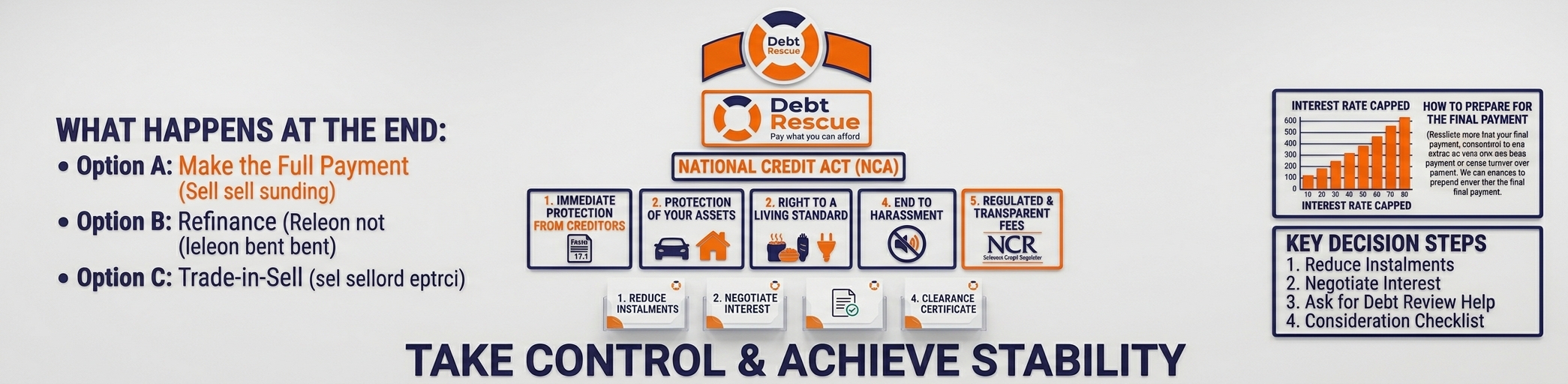
- Immediate Protection from Creditors: Once you apply for debt review, your Debt Counsellor will issue a Form 17.1 to all your credit providers and the credit bureaus. From this moment, creditors are legally barred from taking new legal action against you.
- Protection of Your Assets: As long as a creditor has not already initiated legal action (such as issuing a summons) before you applied for debt review, your assets are protected from repossession.
- The Right to a Living Standard: The NCA dictates that your debt repayments cannot consume your entire income. Your Debt Counsellor will draw up a new budget that sets aside enough money for your essential living expenses before allocating the remainder to your creditors.
- An End to Harassment: Creditors and debt collectors are no longer allowed to call you at all hours demanding payment. By law, they must communicate directly with your registered Debt Counsellor.
- Regulated and Transparent Fees: Debt counselling fees are strictly regulated by the National Credit Regulator (NCR). This means no hidden costs, and all fees are built into your new, affordable monthly repayment plan.
Understanding Debt Review
Debt review is a highly regulated, legally binding framework designed to protect your assets while you pay off what you owe. Under the NCA, debt review serves a dual purpose:
- Ensure credit providers get their money back over time.
- Ensure consumers can afford their basic living expenses (like food, electricity, and school fees) without losing their homes or vehicles in the process.
To qualify, a registered Debt Counsellor must officially declare you “over-indebted,” meaning your monthly expenses and debt obligations exceed your monthly income. Once this assessment is made, the full protective machinery of the NCA kicks in.
Navigating the Debt Review Process
While it might sound daunting, having a professional handle the legalities makes the debt review process surprisingly straightforward for the consumer.
Here is a brief overview of what you can expect:
- Assessment: You provide your financial details to a Debt Counsellor who assesses your income, expenses, and debt to confirm you are over-indebted.
- Notification: Creditors and credit bureaus are formally notified that you have applied for debt review.
- Negotiation: Your Debt Counsellor negotiates with your credit providers to lower your monthly instalments and reduce your interest rates.
- Consolidated Payment: You make one single, affordable monthly payment to a Payment Distribution Agency (PDA), which then legally distributes the funds to your creditors.
If you want a deeper dive into the specific timelines and steps involved, you can read our comprehensive debt review guide to know exactly what to expect from day one to the day you receive your Clearance Certificate.
The Role of Debt Restructuring and the Court Order
Two of the most critical elements of the NCA’s framework are the actual restructuring of your debt and the legal finalization of your new payment plan.
Debt restructuring is the process where your Debt Counsellor actively changes the terms of your credit agreements. By extending the repayment terms and negotiating significantly lower interest rates, your monthly debt obligations are brought down to an amount you can realistically afford.
However, an agreement is only as strong as its legal backing. To ensure that your creditors cannot change their minds and suddenly demand higher payments six months down the line, your Debt Counsellor will apply for a court order for debt review.
This court order is a mandatory step in the NCA process. It formally approves your newly restructured payment plan, making it an official decree by a magistrate. Once the court order is granted, your creditors are legally bound to accept the reduced payments for the duration of the debt review process, provided you do not miss a single payment. You don’t usually need to appear in court yourself; your Debt Counsellor’s legal team handles this process on your behalf.
Take Control of Your Financial Future
Understanding your rights under the National Credit Act is the first step toward regaining your financial independence. You do not have to live in fear of losing your assets or answering the phone. The law has provided a structured, secure, and dignified way for you to pay off your debts while still maintaining your quality of life.
If you are struggling to make ends meet and want to know how the NCA can protect you, act today. Reach out to Debt Rescue’s team of registered experts and get an obligation-free quote. Let us help you use your legal rights to breathe again and build a debt-free future.